Thursday, December 31, 2015

All the World's a Stage

“All the world's a stage, And all the men and women merely players.”

William Shakespeare wrote these timeless words for his comedy As You Like It. It’s a beautiful speech about the ages of Man and how each stage of life can be thought of as acts in a play: infancy, childhood, adolescence, adulthood, old age, etc. These words and that show hold a special place in my heart as the Shakespeare production the Red Deer College Theatre Program’s class of 2004 – my class – performed.

However, I like to think of it in a slightly different, more literal, way.

I think of how theatre plays a part in all cultures around the world and the actual physical buildings that house this important cultural work. After over a year of living in Europe, I’ve been fortunate to see many great, grand, beautiful theatres and I’ve been even luckier to have been able to see some of the performances they harbour.  Each theatre is unique and impressive in its own way, whether it be for its history, architecture or both, and they all have one big thing in common: they are all works of arts in and of themselves that present other works of art.

As my gift to you on this beautiful New Year’s Eve, here are some of my favorite photos of the some of the many different theatres I’ve seen and visited throughout Europe this year. I can't wait to go back to some of them to see more dance and theatre and to celebrate more stories of people around the world.


All the world truly is a stage. 

Palais Garnier, Paris, France.


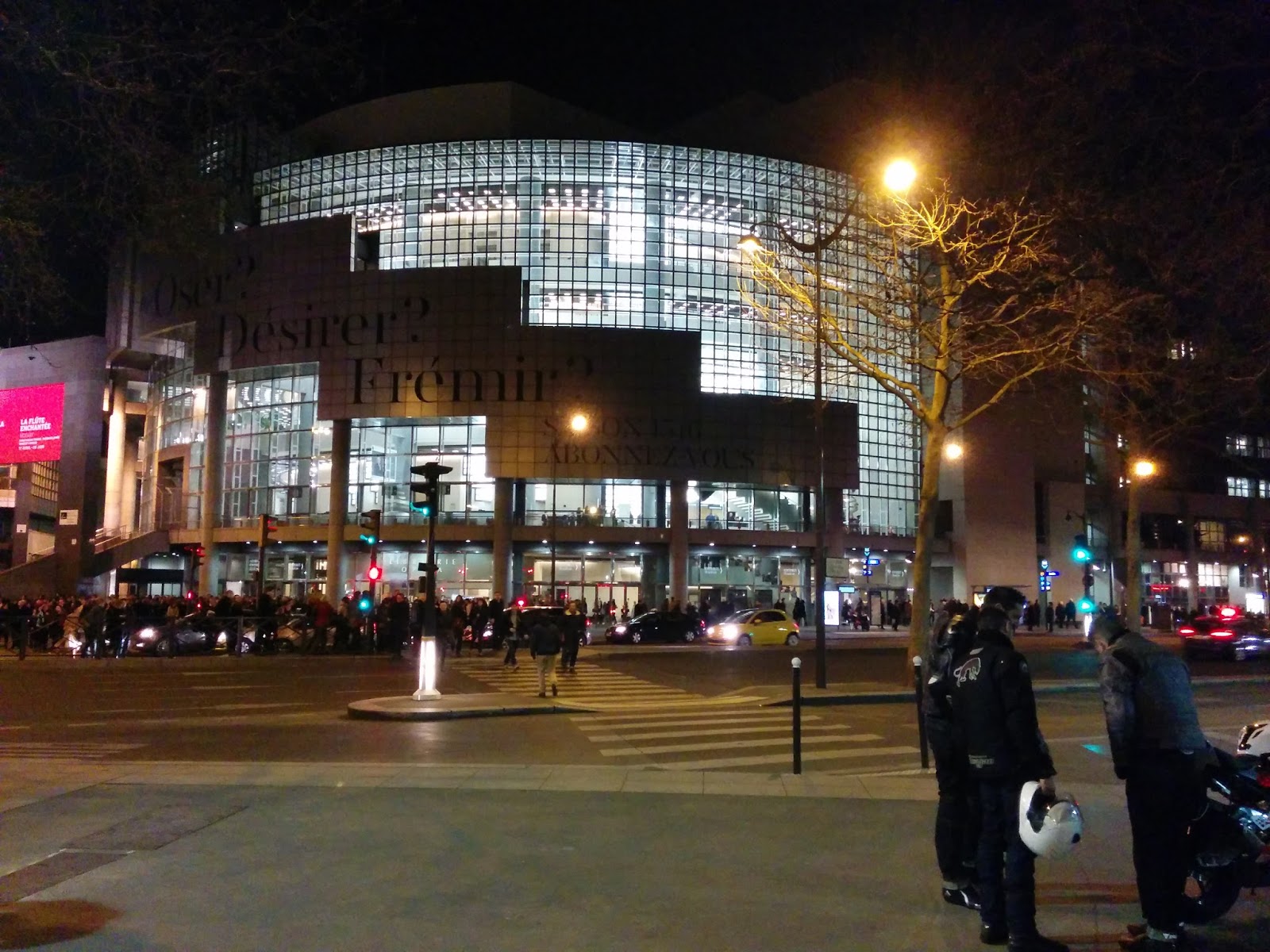
Opera Bastille, Paris. France.


Royal Puppet Theatre, Toone Bar in Brussels, Belgium.


Royal Opera House, London, England.


Victoria Palace Theatre, London, England.


The Globe Theatre, London, England.


Grand Théâtre de Genève, Geneva, Switzerland


Opéra Comédie, Montpellier, France


Strasbourg Opera House, Strasbourg, France


Moulin Rouge, Paris, France.


Monday, December 21, 2015

Paris Opéra Ballet: Rudolph Nureyev’s La Bayadère

With its gorgeous sets and lavish, jewel toned costumes, Opéra Bastille became a portal to an exotic and mysterious new world in Rudolph Nureyev’s La Bayadère.

Opéra Bastille, home of La Bayadère
The sweeping dance, intriguing characters and grand score by Ludwig Minkus all combined with the talents of the Paris Opéra Ballet to tell the tragic tale of love between temple dancer (la bayadère) Nikiya and the warrior Solor.

When Gamzatti, the daughter of the Rajah, who is also betrothed to Solor, discovers her future husband loves another, she swears vengeance and plots the death of Nikiya. At their extravagant engagement celebration, Nikiya must dance for all their invited guests. She is given a basket of flowers, which she believes is from Solor, but unbeknownst to her, Gamzatti put a poisonous snake amongst the blossoms. When Nikiya is fatally bitten, she dies helplessly in Solor’s arms.

Solor then has an apparition of Nikya’s spirit in the ballet’s most famous act, The Kingdom of Shades. In this vision, the two lovers are able to be happy together for a brief moment before the dream ends and Solor is alone.

This production is truly a full company affair as it features many students from the Ballet School of the Opéra National de Paris in supporting roles at the betrothal celebration. No doubt it is an exciting opportunity for the students to perform alongside seasoned company members and I’m sure emotions and nerves were high as they took to the stage. They rose to the occasion and grew more and more confidant with each variation; the small slips in timing, stiff arms and heavy landings will sort themselves out in time and it’s safe to say the future of the company is in good hands.

There’s a reason The Kingdom of Shades is the most famous act of this ballet – it is an absolutely exquisite piece of ensemble ballet. One by one, the spirits file onstage - with their legs and arms for days - descending from a ramp in simple walks, graceful port de bras, and beautiful, sustained arabesques. As more and more dancers enter, the dancers form crisscrossing lines by changing directions and the effect of controlled extensions in perfect unison is utterly mesmerizing. This continues for several minutes until the entire corps de ballet is onstage and then they perform a pristine center adage, beginning with a gorgeous, sky-high developée in second position. It’s interesting to note The Kingdom of Shades act was traditionally performed independently as its own one-act ballet, dating back to its premiere performance in 1903 at Peterhof Palace in Russia.

Rudolph Nureyev’s La Bayadère is a special production for the Paris Opéra Ballet since it was created especially for the company when Nureyev was the Artistic Director in the early 1990s. Its 1992 production was even critically acclaimed and won many awards, which makes it even more bittersweet since it was Nureyev’s last ballet before his death three months after it premiered.

Going to this performance on November 20th was the first time my husband and I had been back into Paris since the November 13 attacks. It’s worth mentioning extra security measures have been added to both Palais Garnier and Opéra Bastille and they provide the necessary reassurance to patrons to be able to enjoy the performances.  

But beyond the extra metal detectors and security guards, the biggest reassurance for me was to see the theatre packed with an excited and appreciative audience and to feel the dancers and musicians feed on their energy. Great art and beauty are always being celebrated in this incredible city, no matter what else occurs, be it the death of a beloved ballet master or an attack on Paris itself. It was very moving to witness the dancers and musicians performing with such passion and I can’t think of a better way to than that to honor the unconquerable spirit of the French.

The curtain will rise again in 2016 and I can’t wait to see what new joys will be presented in this magnificent city of dance, art and culture.

May there be peace and happiness in the New Year for all. Joyeux Fêtes!

The curtain will always rise again
Rudolph Nureyev's La Bayadère runs at Opéra Bastille until December 31, 2015. For more information, visit the Paris Opéra Ballet's website. 

For other posts on the Paris Opéra Ballet 2015-2016 season, check out:

Anne-Teresa De Keersemaeker from November 2015

Friday, November 27, 2015

Paris Opéra Ballet: Anne-Teresa De Keersmaeker

Welcome back to the 2015-2016 season of the Paris Opéra Ballet!

The stage at Palais Garnier is set for another season
of incredible dance.
At the end of October, we were treated to a performance of new works by Belgian contemporary dance choreographer Anne-Teresa De KeersmaekerFeaturing music by Béla Bartók, Ludwig van Beethoven and Arnold Schönberg, the coproduction between the Paris Opéra Ballet and Idéal Audience and Arte, who recorded it for television, was a very unique and diverse evening of contemporary dance.

Quatuor N. 4
The first piece of the evening showcased a four piece string ensemble directly onstage behind the dancers, who were also a quartet. Dressed in simple, yet slightly different black dresses and short ankle boots, the dancers began to shift positions and walk in silence before the music. Silence is such a powerful choice in dance, especially at the beginning of a piece. With nothing else to focus on, the audience is completely drawn into the movement, however big or small, and the experience of that kind of focused energy in a theatre is very exciting.

The music then began without warning or introduction and the dancers launched themselves into the movement with similar abandon and spontaneity. Béla Bartók’s composition has a tense, high-strung quality to it that seeped into the dancers’ movement vocabulary. The music doesn’t build – it starts already at an 8 or 9. The musician’s bows flew furiously as the dancers turned and jumped in succession; their unkempt hair got in their faces as they made their way to the floor and got back up again just as quickly. Their boots gave the piece an interesting percussive quality that was very blatantly unballet-like, as was their sometimes audible exhales. The movement was together but never completely in unison as the dancers each took turns being the one either slightly ahead or behind the others at any given moment. This gave the piece a raw, unpolished impression, as well as a sense of angst and frustration, which in my opinion, are unusual feelings to experience during a performance at Palais Garnier. But I think that was the intention of the piece – it wasn’t what I expected and because of that, it was very interesting choreography to watch.

Die Grosse Fuge
The unexpected kept coming with the next piece, Die Grosse Fuge by Beethoven. More musicians joined the large ensemble of men and one woman, dressed in black suits and dress shoes, onstage. This piece of music was lighter, yet still had an underlying current of melancholy to it, similar to the first piece.

The choreography was very light and flowing – it had a Jerome Robbins flavour to it, with lots of big gallops and tucked jumps; I was at times reminded of the opening scene of West Side Story. The energy was buoyant, yet ‘business-like’, which I saw reflected in the costume design. However, as the dynamics of the music shifted during the 20 minute piece, the number of dancers onstage during the variations changed, and the suit jackets came off to reveal flowing white dress shirts or plain white tees.

I liked the flow of this piece and how the dancers moved so seamlessly from jumping to rolling on the floor. The dancers’ strength was evident in their jumps but nothing felt forced or bigger than it needed to be and their arms had that relaxed, ‘jazzy’ quality to them with no set positions, just used effortlessly. It was a very intriguing piece.

Verklärte Nacht
The final piece, which translates to Transfigured Night, was the most visually unique and stunning of the evening.

Huge tree trunks hung from the ceiling around the back and sides of the stage, which was covered by red leaves or rose petals. The piece was lit entiredly from the sides, which cast dark and mysterious shadows across the stage and the dancers’ themselves as they moved through the light and darkness of the ‘forest’.

The women each wore different styles of dresses, in different fabrics and colours and the men wore a version of a suit/shirt and slacks. The costume design was distinctly ‘uncostume-y’ and gave each dancer a sense of visual individuality, which complimented their individual interpretations of the choreography.

There was a hint of a narrative quality to Verklärte Nacht, but with no set characters or conflict. Thematically, it felt to me to be about a tumultuous love experience. The dancers were brilliant in their solo, partner or group variations and it was wonderful to see the entire ensemble together for what was a beautiful, striking and emotional final piece from this innovative choreographer.

The audience seemed to love it by the number of curtain calls it demanded of the performers and it was a special thrill to see the dancers welcome Anne-Teresa De Keersmaeker herself to the stage to have her moment.

In an art form that holds so much respect and reverence for the pioneers of the past, it felt very special to celebrate new work and to know that bold and exciting choreographers are right here in the present, creating new repertoire to inspire and challenge dancers and audiences alike.

The 2015-2016 Paris Opéra Ballet season is off to great start and I can’t wait to see what’s next. I hope you'll join me again on this year's exciting journey.

Paris Opera Ballet ensemble and choreographer Anne-Teresa De Keersmaeker take their bows together.
For more information about the 2015-2016 season of the Paris Opéra Ballet, go to their website: 

Tuesday, October 6, 2015

In Hamlet’s Footsteps: A Theatrical Tour of Denmark’s Kronborg Castle

The Scene: a blustery day in August.
The Place: Kronborg Castle, Helsignør, Denmark.
The Player stood at the ready in the courtyard, in period costume.
The Crowd gathered in anticipation...

Kronborg Castle, Helsignør, Denmark
And thus began our guided tour of Kronborg Castle, led by none other than Horatio, friend of Hamlet, Prince of Denmark.

Our guide, Horatio, friend to Hamlet, Prince of Denmark
Horatio introduced himself to the group humbly as Hamlet’s servant, though he told us the Prince considered him to be a most trusted friend. He led us out of the courtyard to overlook the Swedish sea. The row of heavy canons stood in their defensive position while the Danish flag flapped proudly in the salty wind behind us.

It was there, Horatio told us while pointing to the flag, that he first heard of a ghost appearing late at night. The grey weather was indeed a strong supporting player in this performance as it added a sense of foreboding around the castle grounds; it wasn’t at all difficult to picture a ghost appearing nearby.

Horatio went on to explain the odd circumstances of the ghost’s appearance: the King is newly dead, the Queen recently remarried her deceased husband’s brother and “something is rotten in the state of Denmark.”

The ghost of Hamlet's father appeared not far from the flag
Our guide then beckoned us to follow him underneath the castle, to a dark, dank, chilly corridor lit by real lanterns. There, among the old piles of stones and the flickering light, Horatio told us how Hamlet insisted those who’d seen the ghost and heard its lament swear not to reveal its tragic secret. His sudden shout of “SWEAR!” shattered the hushed calm and sent a loud echo that clanged off the stone walls, making us all jump and shiver from the sudden goosebumps that spread across our necks. It was a great moment that pulled us even further into the intrigue of the story.

As we wound ourselves through the castle’s dimly lit underbelly, Horatio explained how Ophelia, Hamlet’s love, had tried to follow them through these very passages and eavesdrop on their urgent discussions. Hamlet already had doubts at this point over who he could trust and angrily dismissed Ophelia, telling her to ‘get thee to a nunnery’.
We suddenly found ourselves blinking in the daylight outside the castle once again. Near the gates, Horatio pointed out the place where he and Hamlet greeted the troupe of players and briefed them on his plan: “The play’s the thing, wherein I’ll catch the conscience of the King”.

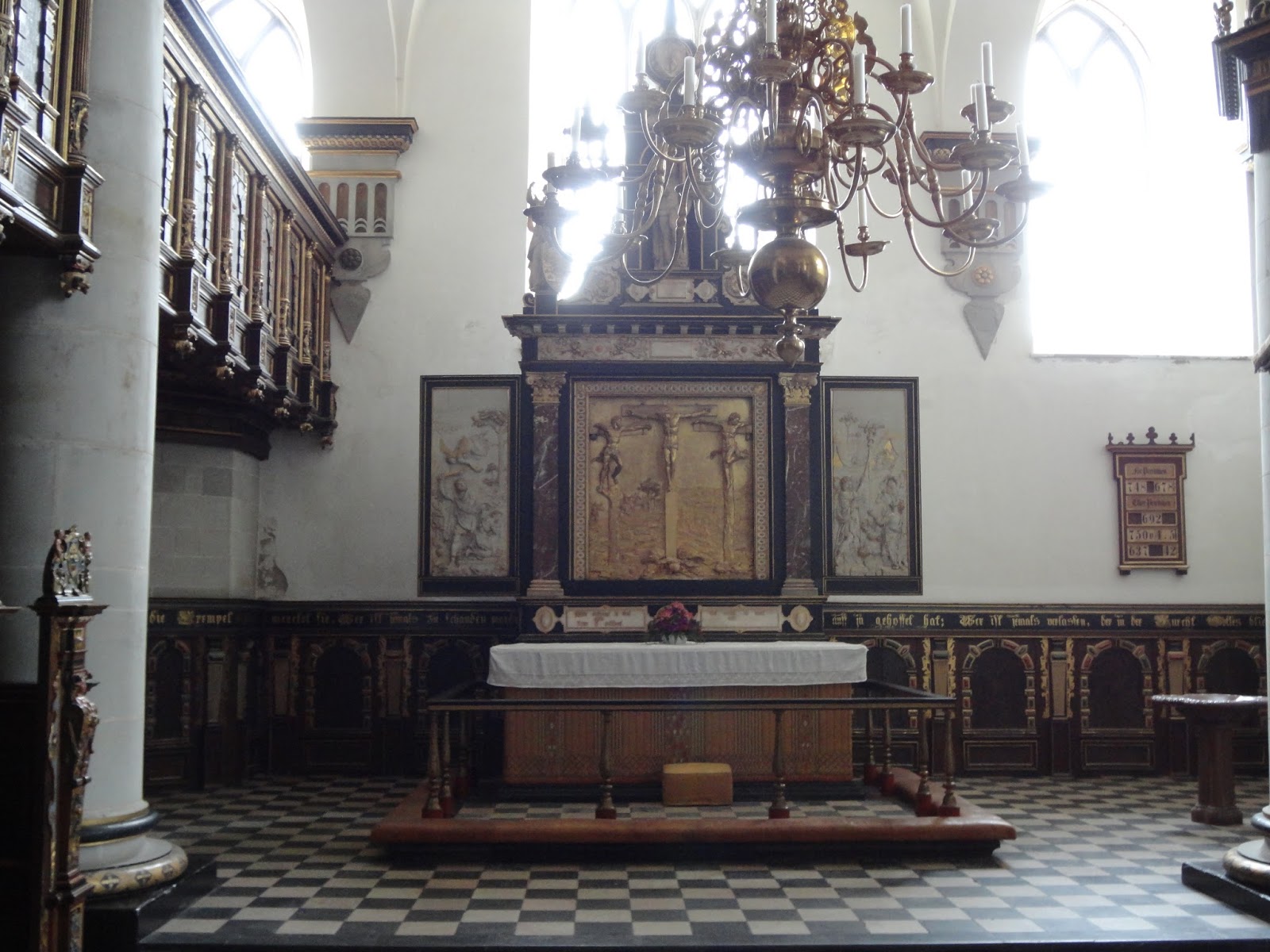
He ushered us into the castle’s beautiful, ornate chapel, where Claudius, deeply shaken from the play’s performance, prayed to God. Horatio indicated the large stone pillars where Hamlet hid and watched his uncle confess but upon hearing his admission of guilt, he could not bring himself to kill him there, in God’s house, for he would surely be damned for all eternity.

The Chapel, where Claudius prayed
He then brought us to the chambers of the Queen.

This was the place, he told us gravely, that Hamlet confronted his mother. As we peered through the narrow doorway into the chamber, our attention was drawn to the large hanging tapestry…it was behind there Hamlet noticed a figure lurking and eavesdropping...surely it was Claudius, the murderer! However, the figure was revealed to be Polonius, who tragically met his end there, stabbed through his hiding place by his daughter’s lover. This moment was one of my favorite of the tour as there was a brilliantly timed thud from within the room, like that of a lifeless body hitting the floor. It brought a terrific feeling of being inside the story as it was unfolding.

We followed Horatio to another small chamber where he had the unfortunate duty of helping Hamlet stash Polonius’ body. We paused in the hallway, next to some tall gilded windows where Horatio told us of a strange conversation they had with some gravediggers about a skull…but there was little time to dwell on this, as word came that Laertes, Ophelia’s brother, had challenged Hamlet to a duel over his sister’s recent suicide following their father’s death. I was reminded again at this point just how many bodies this play leaves in its wake.

The musician's box, where Polonius' body was stashed
Finally, we reached the Great Hall, were the climactic duel between Hamlet and Laertes took place. It was a grand room, with a smooth, polished stone floor, tall windows, and dangling chandeliers. Horatio’s tale picked up speed as he relayed the highlights of the duel: the unexpected points Hamlet scored, the poisoned foils and the King and Queen both dying from poisoned drink. His voice was full of emotion as he told us how as Hamlet lay dying and Horatio himself was prepared to follow his friend into the afterlife, the Prince made him take one more vow – to share the tale of what really happened here at Helsignør, to dispel the rumours and to keep his memory alive – hence his reason for taking us on the tour.

The Great Hall, setting of the final duel and body pile-up
The In Hamlet’s Footsteps Tour was a fascinating theatrical experience. The Horatio character makes the story quite accessible to those who aren’t familiar with Shakespeare’s play - it’s basically an ‘essential plot-points’ version. For those who have studied or seen Hamlet before (as I have – three different times), it was exciting to experience the story in its inspired setting and to anticipate where in the castle we’d go next.

In only 45 minutes, we got to experience all the spookiness, lies, deceit, intrigue, murder and bloodiness of one of Shakespeare’s most popular tragedies in one of UNESCO’s World Heritage Sites. It couldn’t have been set in a more beautiful and interesting place, fitting, considering Shakespeare himself once said: “All the world’s a stage…”

My pal Will Shakespeare


Monday, August 3, 2015

Les Étés de la Danse: Alvin Ailey American Dance Theatre

The mandate of Paris' annual dance festival, Les Étés de la Danse, is “[to] offer… to French and foreign audiences an appointment with the largest dance companies worldwide”. This summer’s guest company was the incomparable Alvin Ailey American Dance Theatre.

Since dancer Alvin Ailey created his own company in 1958, it has become one of the most prolific modern dance companies in the world, “[going] on to perform for an estimated 25 million people at theaters in 48 states and 71 countries on six continents”. When I saw the billboards for their show in the metro and around Paris, I knew dance audiences in Paris were in for a very special treat.

Good advertising!
My friend Sheila emailed me this beauty

AAADT graced the stage at Paris’ Théâtre Châtelet from July 7 to August 1. Throughout the past month, audiences were treated to a different performance each night, culled from the company’s rich repertoire of Ailey classics and guest commissioned choreography. I was lucky enough to witness one of these performances of four stunning and diverse pieces and with my friend Sheila as my date, it was a terrific way to spend a hot July evening in Paris.

Outside the beautiful Theatre Chatelet
Four Corners (2013)
This was the Paris premier of choreographer Ronald K. Brown’s piece. Dynamic and fast-paced, the dancer’s didn’t stop moving for the entire 24 minute-length of this opening piece. The choreography was inspired by traditional African dance, as well as the beautiful head wraps and flowing dresses of the costume design. The dancers’ knees were soft and the only time they stood up straight was for a split-second before the lights cut to blackout. Even the jumps were incredibly grounded - they traveled more horizontally than vertically, which increased their power and impressiveness. This piece was an effective introduction to the company’s diverse style and talented dancers.

After the Rain Pas de Deux (2005)
Christopher Wheeldon’s stunning pas de deux was another Paris premier by AAADT, beautifully danced by Akua Noni Parker and Jamar Roberts. It was a blend of strength, vulnerability and grace; the haunting piano score by Arvo Pärt and the dancer’s fluid and controlled extensions brought a hush over the audience. The lifts were effortlessly executed, as was the simple and precise contemporary ballet technique. It was a gorgeous piece of dance and a thrill to see Wheeldon’s work live.

Bad Blood (1984)
Act Two premiered Ulysses Dove’s 1984 piece of powerhouse modern dance. It was sharp and commanding, “merg[ing] the influences of [Dove’s] choreographic mentors, Alvin Ailey and Merce Cunningham”. Through three different male-female duets and one male solo, it explored feelings of tension, confrontation, and “emotional passion”.  It was modern dance at its most athletic and physically demanding. The lifts were intricate and showcased the strength of both partners, especially when they sometimes turned into tosses. The industrial, pop-flavoured score by Laurie Anderson and Peter Gabriel was a new and welcome direction for the show to take and once again highlighted the company’s exciting stylistic range.

Home (2011)
Rennie Harris’ Home brought a satisfying conclusion to an arc that began with the traditionally-inspired Four Corners and finished in a modern, urban, hip-hop world. The dancers were tough and bold, breaking away from unison and conformity by wearing everyday street-clothes and by putting their own individual stamps on the movement. There was a rawness and an intensity to this piece that was different than Bad Blood. It could be felt through the crisp isolations, head movements, “intricate footwork and rapidly-evolving patterns”, as well as through the “pulsing gospel house music score by Dennis Ferrer and Raphael Xavier”. Home was my favorite piece of the evening because the dancers felt so loose and free. It was hard not to groove along with them from my seat and it was great to end the evening on a courageous, hip-hop note.

I feel so fortunate to have seen this amazing company perform live at Théâtre Châtelet. Though the beautiful old theatre offered little relief from the outside summer heat, it was a great venue to showcase a talented company to a very excited and appreciative audience.

The next stop of Alvin Ailey American Dance Theatre's international tour is South Africa and I have no doubt they will be as warmly welcomed there as they were here in Paris.

To check out gorgeous photos and video clips of their many dances, check out Alvin Ailey American Dance Theatre’s website:


Beautiful photos of beautiful dancers


Monday, July 20, 2015

Paris Opéra Ballet: La Fille Mal Gardée

Girl loves Boy, Boy loves Girl. Mother disapproves of Boy, prefers Other Boy for Girl. Other Boy is a fool. Girl and Boy get married. The Chickens dance and the Peasants rejoice.

The amazing ceiling at Opera Garnier by artist Marc Chagall.
Such is the plot of La Fille Mal Gardée

The recent Paris Opéra Ballet production of this 200 year old classic ballet is a fun, light-hearted romp of young love and silly hijinks in the lovely countryside. It’s comedic ballet at its best, complete with a chorus of dancing chickens, a lively harvest festival, and a carriage hitched to a real-life horse! 

Lise and Colas are in love but her ridiculous and overbearing mother, the Widow Simone, prefers she marry the rich but dull and foolish Alain. At the village’s harvest festival, Lise performs an intricate ribbon dance with Colas and the other young ladies of the village. The Ribbon Dance is one of the most well-known scenes in this ballet, and for good reason: it showcases a beautiful moment of pure strength and faultless technique when Lise, in the centre where the maypole would normally be, holds the ribbons of her eight fellow ballerinas while balancing in a perfect attitude promenade en pointe, whilst they circle around her. No easy feat but it was brilliantly executed and joyfully danced by the leading lady and the corps de ballet.

We could see two performances for our seats: the dance and the music.
Alain attempts to woo Lise but is too awkward and foolish to notice the lovers stealing glances and sneaking kisses during an elaborate and humorous trio variation. Even the Widow Simone lets loose with the girls in a spirited folk dance, the other famous dance of this ballet – the Clog Dance. The ladies donned bright yellow clogs over their pointe shoes and stomped out a delightful rhythm, which added a fun, percussive element to the dance and the score. But the merriment was short-lived and a thunderstorm scattered the revellers at the end of Act I, providing some exciting storm special effects from the lighting and sound designs.  Alain was even swept away on the wind with his umbrella as the curtain fell.

Act II dawns inside Lise and Widow Simone’s cottage, with Lise’s attempts to sneak away to Colas thwarted at every turn by her mother. Even after a rousing tambourine dance, the old woman just won’t fall asleep! She insists the Alain-Lise marriage will go ahead no matter what and locks Lise inside the cottage while she leaves to fetch the notary and the bumbling Groom. Unbeknownst to her and Lise, who throws a hilarious temper-tantrum out of frustration, Colas sneaks inside when some of the harvested crops are brought into the cottage. From his hiding place, he witnesses Lise professing her love for him via a dreamy solo enactment of their future: first the proposal, then marriage, then several baby carriages…if she could have written their initials inside a giant sparkly heart onstage, she would have. 

Colas reveals himself to an embarrassed Lise and the two hide when Widow Simone returns with Alain, the officiant and the entire village as witnesses. The lovers are revealed when Alain botches the proposal and though initially furious with her wayward daughter (as is the translated title), she eventually blesses their love and follows them, along with the whole village, to the wedding ceremony…all except Alain, who sneaks back inside, amidst much laughter from the audience, to retrieve his prized possession – his umbrella!

We had fantastic seats in one of the side-boxes.
This ballet’s accessible plot and characters were enjoyed by all ages of ballet patrons, as the consistent laughter indicated. The sets, depicting the gorgeous French landscapes, were amazing and vividly realized by the design team: a sweet little cottage exterior and yard (where the Chickens stole the first scene), transformed seamlessly into a picturesque field for the harvest festival and then into the cozy interior of the cottage for the final act.

The principal character roles were danced and acted with heart and gusto – it wasn’t hard to notice how much fun the dancers were having bringing their loveable characters to larger-than-life, especially Alain and Widow Simone. The lovers, Lise and Colas, had a sweet and sincere chemistry and their partner work was able to rally from a few shaky lifts.

La Fille Mal Gardée was a wonderful show to cap off our series of ballet performances this year: the razor-sharp technique of Lander’s Etudes, the weight and flow of Forsythe’s choreography, the innovative reimagining of Romeo and Juliet, the contemporary day in a life of Le Chant de la Terre, the classic and heartbreaking Swan Lake, and the comedy and characters of La Fille Mal Gardée. Here in France, where ballet was born, the tradition of ballet excellence and innovation is alive and thriving.

I've loved watching every performance with this man.
As a dancer and a writer, it’s been a dream come true to share my experiences on this blog. I sincerely thank you, dear Readers from around the world, for following these posts and for your comments and tweets. I must also thank two very special people who made this Paris Opéra Ballet viewing experience a reality – my amazing husband Mike and Salena, my talented sister, fellow dancer and writer, who worked together to choose these performances for an incredible anniversary gift.

And finally, to the dancers, choreographers, musicians, designers, and Front of House staff at Opéra Garnier and Bastille, thank you for all that you do. It’s truly been an honor and a privilege to witness the variety and depth of ballet dance.

Merci et félicitations à tous et à toutes à l’Opéra de Paris. À la prochaine saison!

Bring on the 2015-2016 Season! 


The balconies make excellent barres.
One very happy Dancer Abroad!
Re-live the past season by checking out my previous posts on the ballet in Paris:

Swan Lake on World Theatre Day from April 2015

Le Chant de la Terre  from March 2015

The Swedish Royal Ballet: Juliette et Romeo  from January 2015

Lander/Forsythe from September 2014

Danse Classique in Paris from September 2014

Tuesday, June 30, 2015

Musique in the City of Lights

June is always a special month: the sun stays out longer, the temperature gets warmer and Summer is embraced like the old friend you haven’t seen since…well, last summer. 

Patios open up. Umbrellas provide cool shade and a kitschy garnish to a cocktail. Laughter, BBQs and Drinks all join in on Summer’s welcoming committee. But the moment’s not really complete unless Music makes an appearance.

I’ve noticed an increased musical presence in Paris the last month and I suspect Summer is a big part of it. Paris and Summer like to show-off together, especially for the huge numbers of visitors that show up in the city during the warm, vacation months and Music is another big draw.  There’s so much going on and I’m excited to share some of my Paris Musique experiences in these early days of Summer.

Paris in the Summer.
Note - no pun intended...well, maybe a small pun intended - I’m not a musician myself, nor do I have a lot of knowledge of musical arrangements, technique or terminology. I’m purely a fan of that which gives dance its heartbeat, ‘makes the world go round’ and turns an ordinary night into a magical Summer Night. With that mind, I hope you enjoy some of my stories – and videos! - of where I’ve found Music this summer so far in Paris.

1-Metro Buskers and Street Performances:

Ah, the Paris Metro: it’s a loud, stuffy, often crowded, often smelly place where, thankfully, I don’t have to spend too much of my time. But it’s never failed to get me where I need to go. I’m usually within the window of being ‘on time’ and the eccentric passengers make every ride a rich, people-watching experience. There's never really a dull moment.

The Metro buskers can provide some interesting mini-shows and I’ve been lucky to see some really good ones:

On one trip on Line 6, we were treated to a surprising performance of French Rap, with both a live accordion and a stereo of remixed-bass. It was really fun and much different than the standard ‘Vie en Rose’ on the accordion performance. I gave them a few euros for their show. And another time on Line 1, a small band was playing some really beautiful classical guitar but I had to get off before I could hear the rest of their set.

Then there are the really bad, cringe-worthy ones – like on the time on the RER B when a man was trying to sing a Spanish version of ‘Sorry Seems to be the Hardest Word’ and the lady next to me said it wasn’t Spanish at all – it wasn’t even close! My sister-in-law and I had to bite our tongues to not laugh out loud at this comment. Awkward…

The steps of Opera Garnier are a popular spot for street performers at all times of the day and night. The video I took was of a singer who consistently plays there and even sells his own CD. My friend and I thought he was great, but we both have soft-spots for late ‘90s/early 2000’s boy-band pop songs…


As far as paying goes, if I enjoy a metro or a street performance and I feel safe getting out my wallet in that setting, I’ll give a few euros to the performer. This is my own personal rule and I hope you feel empowered to do whatever makes you feel comfortable in that situation.

2-Concerts at Saint-Chapelle, or any cathedral:

There are so many amazing cathedrals in Paris and many of them host concerts throughout the year. I wanted to go to one at Christmas but it was a busy time and we weren’t able to fit it in. 

But finally seeing a performance of Pachelbel’s Canon and Vivaldi’s Four Seasons at Saint-Chapelle was completely worth the wait.

It was a beautiful experience in every sense: the stained glass windows of Saint-Chapelle are absolutely breathtaking and the perfect acoustics of that cathedral made a small ensemble of six musicians (four violinists, a cellist and a pianist) sound like a full orchestra. The sunlight caught the colours of the windows as it slowly set and their light and the soaring music seemed to wrap the intimate space around us. 

Sometimes, I just shut my eyes and listened to music swirling about. But as much as I loved just listening, it was interesting to see how the music was played - the movements of the bows and the musicians' fingers were so fast and intricate. I also enjoyed watching how the musicians interacted with each other, especially during the flurry of violins in the Winter selection. They were truly and joyfully playing together and spiriting each other onward. I could sense a deep respect for each other and for the music, and a love for performing. Music is experienced through the ears but it's played with the whole body. It was almost like a dance.  

I get it now when people rave about Saint-Chapelle. It's so beautiful!
For this performance, we found it extremely easy to buy our tickets online and print them off at home. We had to go through security as we entered, just as anyone does at any major museum; this is why our tickets advised us to line up 45 minutes before the performance. There are many sites to buy tickets to these kinds of concerts; just check out the links below:


And it should go without saying, but I’ll say it anyway: during any paid performance in a theatre, silence all technology and only take photos before or after the performance!

3-La Fete de la Musique:

This is an annual celebration on June 21 – no matter what day of the week – where the French celebrate the Summer Solstice with free concerts and music everywhere. There are organized performances but it’s also completely open to the public and anyone can play music wherever they want (within reason, of course).

This lady sang both rock and folk, Pink and Stevie Nicks!
We enjoyed the smaller venues set up in the 14th arrondissement; we know that area well since that's where we lived for the first month when we moved here last summer. All along Boulevard Montparnasse, there were small performances in restaurants and three larger set-ups near Edgar Quinet Metro station. 


It was definitely strange to hear Nirvana songs performed with French accents but the bands there were really fun! We were even serenaded by a young man who did an impressive cover of Ed Sheeran’s A Team while we dined on delicious galettes and crepes on Rue Gaite, or as we affectionately call it, Crepe Street.

A few tips for future Fetes de la Musique:
1-Bring water!
2-Wear comfortable shoes and sunscreen!
3-It really gets going after 8PM or 20H.
4-It gets busier and more crowded near bigger metro stations – like Republique  - later in the evening. If that’s your scene, enjoy! You should also check out this website for more information about what’s happening where. Personally, I enjoyed the smaller venues more but that’s just me.

Whether it’s a musical-quicky on the metro, or a full-on classical music concert, Musique is alive and well in Paris in the summer. There seems to be something for everyone and seeing as we’re really only nine days into the official season, it’s only just beginning.

So strike up a song, Music.


Summer, let’s dance.